»This approach and proposed solution has enormous potential and can / will lead to progress in the automation of all welding processes. The precise laser sensor technology shown in combination with the synchronized rotary axis can increase the stable quality (later also quantity) and thus optimize costs.«
René Köke - Managing Director DEWE Stolz Energiesysteme GmbH
DEWE Stolz Energiesysteme GmbH
Contact at the AI Innovation Center
Werner Kraus
Automated welding of pipe connections
Initial situation
Welded pipe connections are used in both traditional heating manifolds and district heating transfer stations. These pipe connections are welded manually, as there is currently no cost-effective automation solution that can compensate for existing manufacturing deviations. Automating these connections can therefore represent a considerable cost saving.
Solution idea
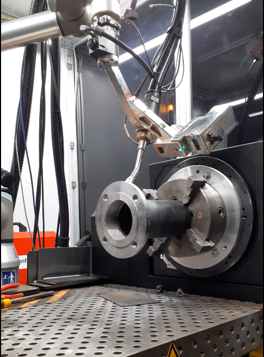
The components are clamped in a controlled axis of rotation. A laser sensor mounted on the robot records the component during rotation. Deviations and tolerances are calculated and compensated for from the measurement data. The robot adjusts its welding path in real time, which means that deviating components can also be welded.
Implementation of the AI application
Automated assemblies consist of a base tube and flange. A laser sensor mounted on the robot scans the pipe and flange surface without contact, determines the intersection point and calculates a reference point. Defined offsets determine the welding path. The robot coordinates the welding source and rotary axis synchronously, executes the seam and ensures a fully automated process.