»Together with Fraunhofer IPA, we were able to implement a maintenance chatbot with RAG on our MLSoC platform as part of the Quick Check. Our Modalix SoC platform, a market leader in Physical AI, enables increased productivity on production lines and during employee onboarding, thus also helping to address the shortage of skilled workers.«
Stephan Reichenauer
SiMa.ai
Contact at the AI Innovation Center
Christof Nitsche
Intelligent Production Assistant on Edge (IPA Edge)
Initial situation
Modern production environments in discrete manufacturing and in relevant areas of the process industry are under high pressure to be efficient and suffer from a shortage of skilled workers. Employees working on the machines have to control production, optimize parameters, rectify faults and carry out basic maintenance at the same time. The knowledge required for this (error codes, setting values, process and maintenance instructions) is distributed across extensive documentation and various systems. Access directly at the machine is often difficult: search efforts are high, network connectivity is not always available, data protection requirements limit cloud use. The consequences are lost time, avoidable errors, increased workload and extended downtimes. Existing knowledge management and support processes do not offer the necessary speed and reliability on the store floor. With this in mind, the Quick Check should examine the basis for local, real-time capable and data protection-compliant support at the workplace.
Solution idea
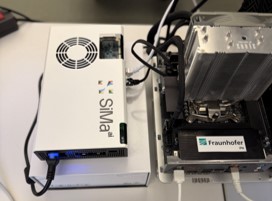
IPA Edge is an AI production assistant that runs locally, cloud-independently, and without additional infrastructure on a SiMa-MLSoC platform. At its core is an LLM specialized in production knowledge (documentation, process descriptions, error catalogs, maintenance instructions). Employees interact via voice or text input; the assistant explains error codes, provides step-by-step instructions, recommends parameters, and supports diagnostics and basic maintenance. Edge execution makes the system capable of real-time operation, available offline, and compliant with data protection regulations. The goal: faster problem resolution, reduced downtime, higher process reliability and quality, and centrally accessible expertise. The Quick Check evaluated the LLM performance, 2-3 core use cases, data sources, integration paths, and acceptance.
Implementation of the AI application
Two possible scenarios were implemented:
a) LLM API on SMA MLSC, external vector database (simple, fast)
- LLM runs locally as a REST/gRPC service on the hardware.
- RAG about external vector database: documents are hosted externally, embedded, and indexed; queries retrieve top-k context from the database and pass it to the local LLM.
- Advantages: low integration risk, rapid iteration, quick PoC (Proof of Concept). Disadvantages: network dependence and potential data leaks depending on hosting.
b) Entire system fully on hardware with embedded Vector Database
- LLM, embedding model, and vector database are integrated on the MLSC.
- On-device Ingestion: File import, chunking, embedding, and index building; RAG fully offline.
- Optimizations: Quantization, streaming/chunked decoding, memory and thermal management, simple admin UI/CLI for configuration.
- Advantages: Real-time, offline capability, data sovereignty/IP protection; Disadvantage: higher engineering and resource expenditure.