

Hybrid-Airplane Technologies GmbH
Contact at the AI Innovation Center
Xinyang Wu
AI use cases for the h-aero® platform
Initial situation
Hybrid-Airplane Technologies GmbH develops, operates, distributes and rents out a sustainable hybrid aircraft: the h-aero® is a hybrid aircraft that combines the known physical principles of flight (aircraft, helicopter, balloon) for the first time and minimizes energy consumption by combining static and dynamic lift. It is suitable for carrying out autonomous data collection tasks using various sensors. Complex tasks of this kind can often only be tackled with flexible learning algorithms. However, due to the large number of potential use cases, no prioritization has yet been made in this regard.
Solution idea
The aim of the AI Explorer was to identify the most promising use cases and at the same time provide an overview of the landscape of AI applications for a wide range of sensor systems and application domains. The aim was to prioritize the use cases in order to make optimal use of Hybrid-Airplane Technologies GmbH's resources and at the same time increase the chances of rapid and profitable implementation.
Benefit
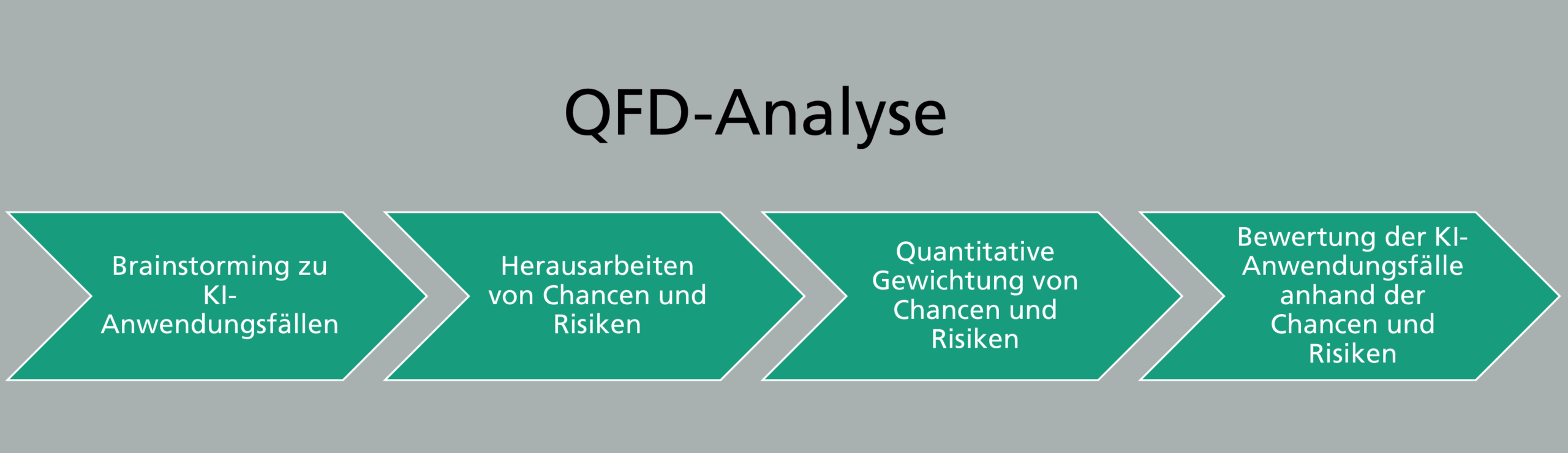
The systematic approach using a QFD analysis made it possible to quantitatively assess the respective potential of the individual AI use cases based on objective criteria. The results of the analysis can help Hybrid-Airplane Technologies to use AI profitably in the near future and implement ideas more efficiently and in a more targeted manner.
Implementation of the AI application
In a brainstorming session, all kinds of use cases were first collected that could potentially be implemented on the h-aero® platform. The ideas were categorized into the four areas of carrier, interior, exterior and photogrammetry. The second step involved identifying opportunities and risks and weighting them numerically. Finally, the 22 use cases were evaluated with regard to these opportunities and risks. In this analysis, the self-calibration of the carrier, the learning of limitations and anomaly detection performed best.